
Movements
"The best car analogy I can find is the Valjoux 7750 and the Lemania 5100 are the Chevy 350 and the Ford 351-C of watches. Both are tried and true designs, nigh bulletproof when treated with a modicum of care, with outstanding parts availability and as common as dirt." - Chuck
01
Valjoux 7750
General Notes:
- Unveiled in 1973, the Valjoux 7750 is one of the most iconic and enduring automatic chronograph movements in Swiss watchmaking. Developed by Valjoux, it was designed to be robust, reliable, and easier to mass-produce than its column-wheel predecessors like the Valjoux 72. In reaction to the proliferation of the Chronomatic Cal. 11/12/15’s and the JRGK version of said, Valjoux was losing market share in their wholesale business because their 773x movement line was still handwound. The market wanted automatic chronographs and Valjoux quickly developed the 7750 as an evolution to the 7734. Using Computer Aided Design (CAD) for the first time in the industry, the 7750 was designed quickly to be mass-produced and serve as the new workhorse movement.
- The original 1973 version of the movement had 17 Jewels, and it includes a quick-set day and date mechanism and supports chronograph functions with a central seconds hand, 30-minute and 12-hour counters, and small seconds.
- Despite a promising start, production of the 7750 was halted just two years after launch due to the quartz crisis, which devastated the mechanical watch industry. However, the movement saw a revival in the 1980s as the market rebounded, and it has since become a workhorse for countless brands, from TAG Heuer and IWC to Tudor and Sinn.
Valjoux 7750 Rotors:
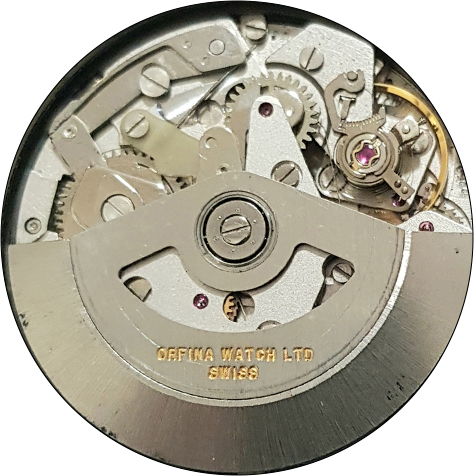
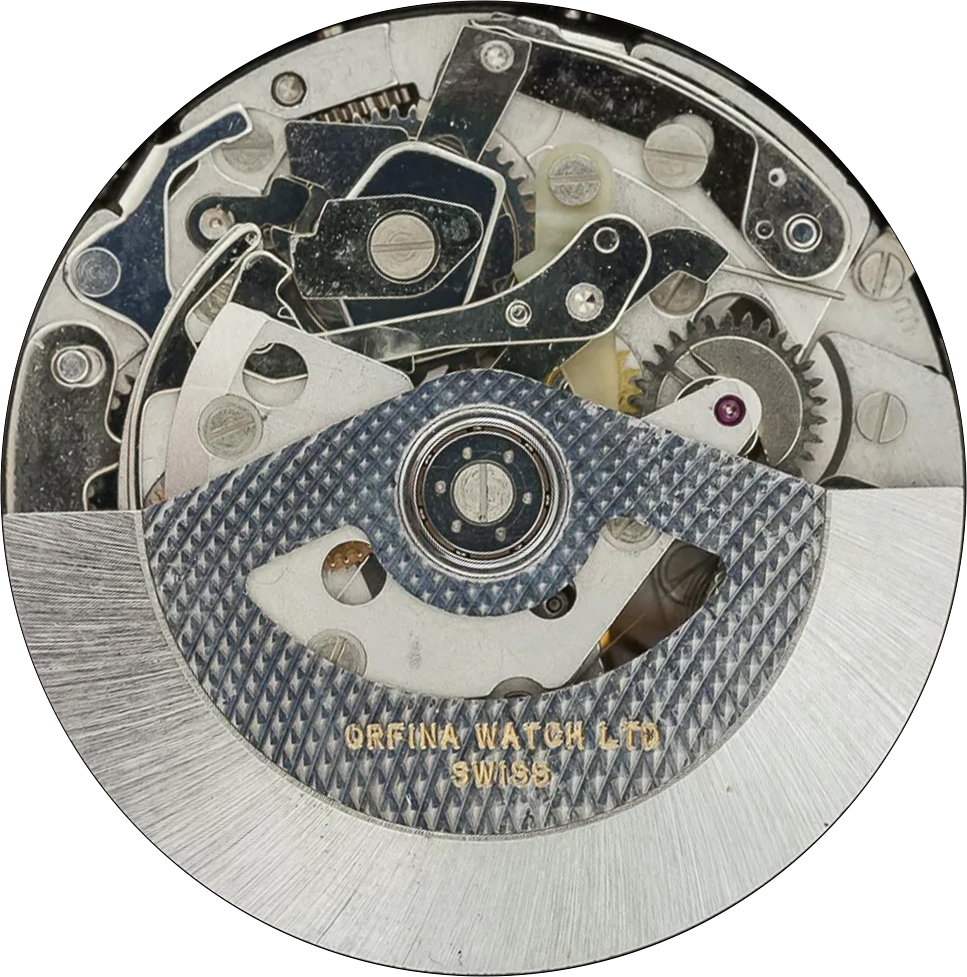
- Marked “ORFINA WATCH LTD SWISS” in two lines with “SWISS” engraved below “ORFINA WATCH LTD” filling the lower part of an insert surrounding the central bushing.
- The rotor is known to exist in 2 finishes, with the earliest examples being a simple brushed metal unit. These were followed by a guilloche-finished insert that began being used during the Orfina dial period and would continue to be used until the end of 7750 model production.
Click to zoom
Mk. 1 Valjoux 7750 Rotor
Click to zoom
Mk. 2 Valjoux 7750 Rotor
02
Lemania 5100
General Notes:
- Introduced in 1974, the Lemania 5100 stands out as one of the most utilitarian and function-driven automatic chronograph movements of its era. Developed by Lemania during a time when the mechanical watch industry was being battered by the quartz crisis, the 5100 was purpose-built for durability, affordability, and ease of mass production. With military, aviation, and tool-watch applications in mind, the movement incorporated practical materials like Delrin plastic for non-critical components and utilized a simplified cam and shuttle chronograph mechanism - favoring reliability over visual refinement.
- The movement featured 17 jewels, and a 48-hour power reserve. What made the 5100 especially distinctive was its central chronograph minutes and seconds hands, allowing for instant readability - alongside a 12-hour totaliser at six o'clock, small seconds at nine o'clock, 24-hour display at twelve o'clock, and day-date function at three o'clock.
- Militaries have strict standards for any issued equipment - it must be functional, cost-efficient, and robust. The Lemania 5100 checked all three boxes. To enhance durability, Lemania added structural supports on either side of the movement, increasing its shock resistance. Uniquely, the 5100’s chronograph seconds hand used a direct-drive system, rather than the more common intermediary wheel - eliminating a point of failure. This made the movement virtually immune to shock-induced stoppage under all but the most extreme conditions. In fact, it was famously capable of withstanding up to 7 Gs of force without its chronograph hand halting, earning it a place in fighter jets, cockpits, and military-issue watches.
- Although never lauded for finishing or aesthetic beauty, the Lemania 5100 earned a cult following for its bulletproof engineering. It was used by brands like Sinn, Bell & Ross, Fortis, Tutima, Heuer, and Omega. Production ended in 2002 after Swatch Group absorbed Lemania, but the 5100 remains a benchmark of functionality-driven design and one of the most respected "tool watch" movements ever made.
Movement Serial Numbers:
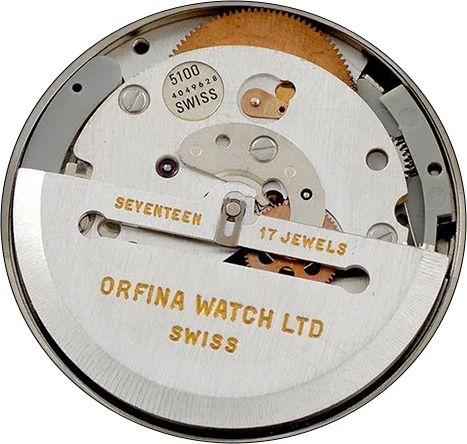
- The earlier movement serial is a circle that is embedded in the watch movement, where a sticker displays the movement’s serial.
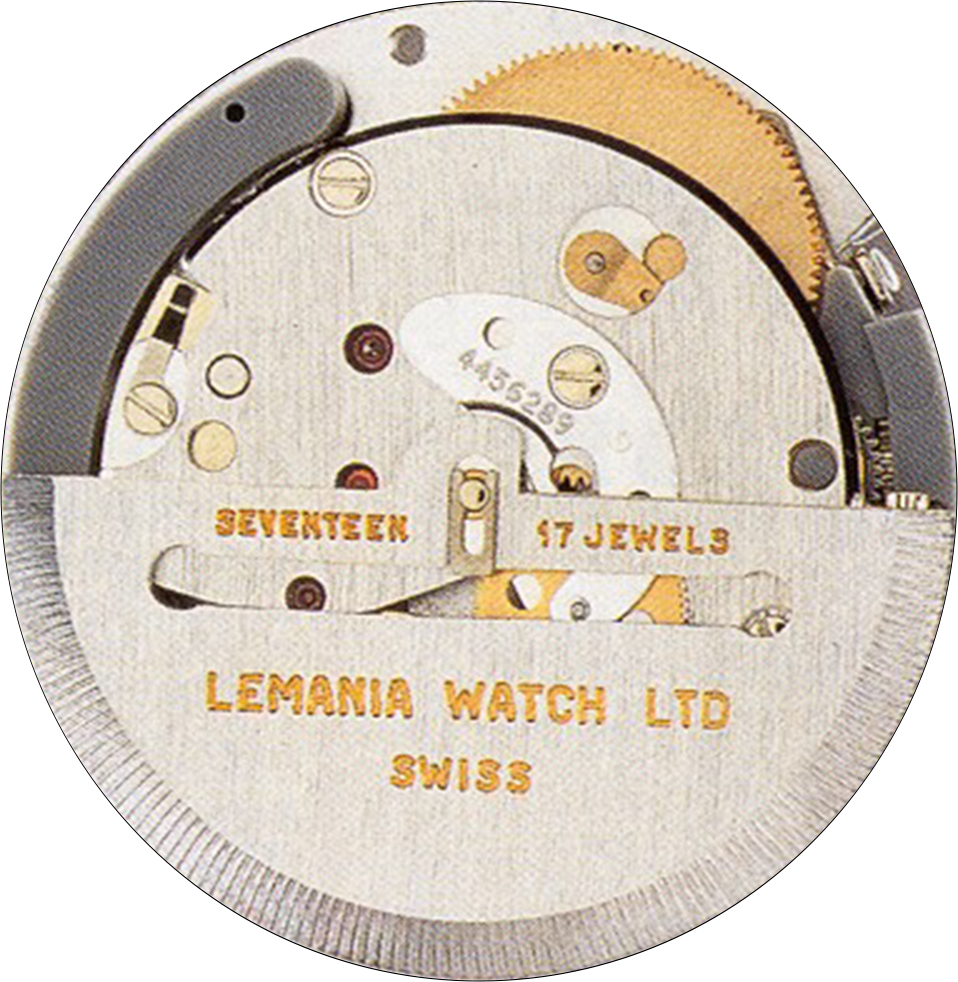
- The later version features a curved metal piece on top of the movement, but underneath the rotor, which has the movement’s serial number engraved into it.
Click to zoom
Lemania 5100 Serial Type 1
Provided Serial: 4049628
Provided Serial: 4049628
Click to zoom
Lemania 5100 Serial Type 2
Provided Serial: 4436289
Provided Serial: 4436289
03
Lemania 5100 Rotors
Mk. 1 Lemania 5100 Rotor
- Marked “ORFINA WATCH LTD SWISS” in two lines with “SWISS” engraved below “ORFINA WATCH LTD” .
Mk. 2 Lemania 5100 Rotor
- Marked “ORFINA WATCH LTD SWISS TKZ 5100 BW” in three lines with “SWISS” engraved below “ORFINA WATCH LTD” and “TKZ 5100 BW” engraved below “SWISS”.
Mk. 3 Lemania 5100 Rotor
- Marked “LEMANIA WATCH LTD SWISS” in two lines with “SWISS” engraved below “LEMANIA WATCH LTD” .
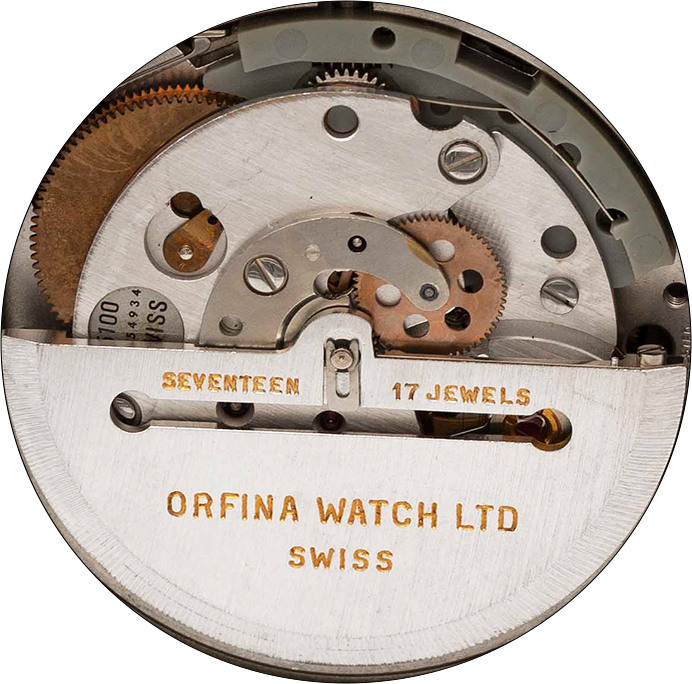
Click to zoom
Mk. 1 Lemania 5100 Rotor
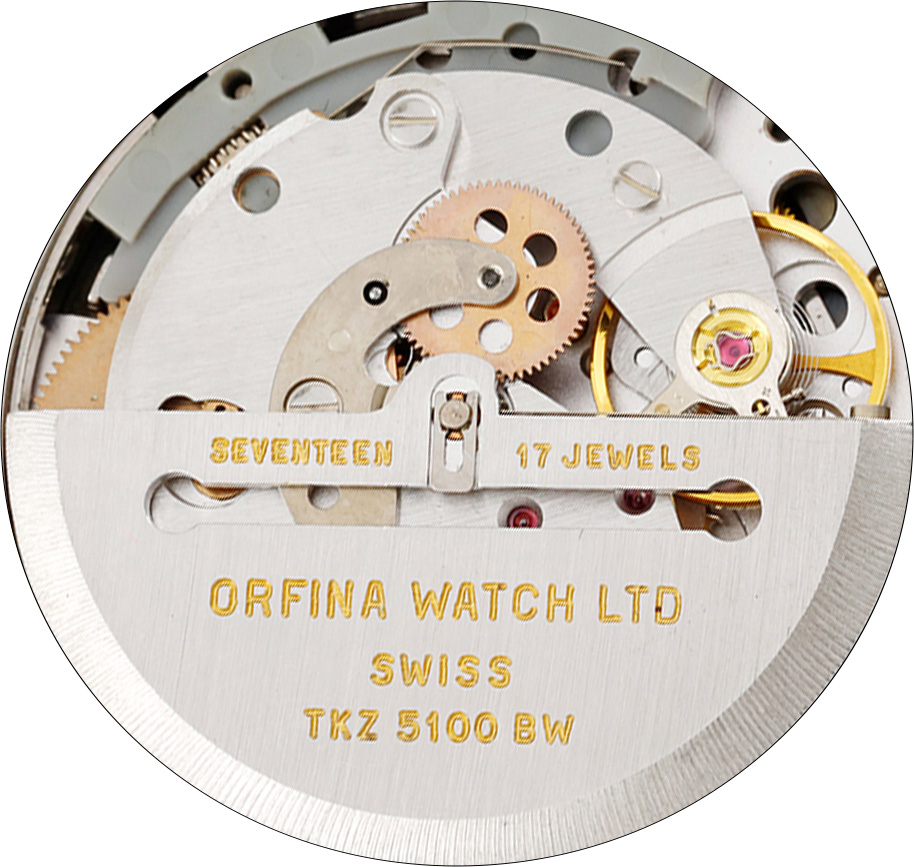
Click to zoom
Mk. 2 Lemania 5100 Rotor
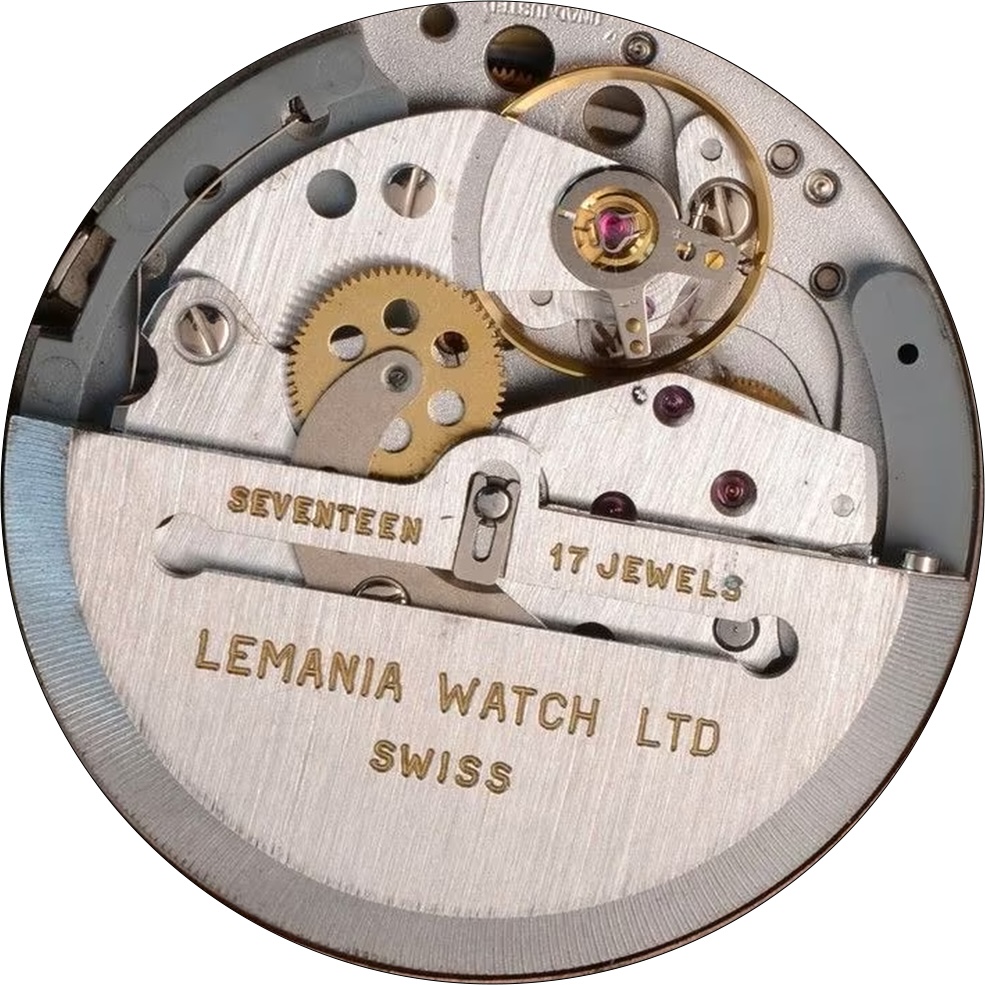
Click to zoom
Mk. 3 Lemania 5100 Rotor